How Do You Dispute Credit Report Errors?
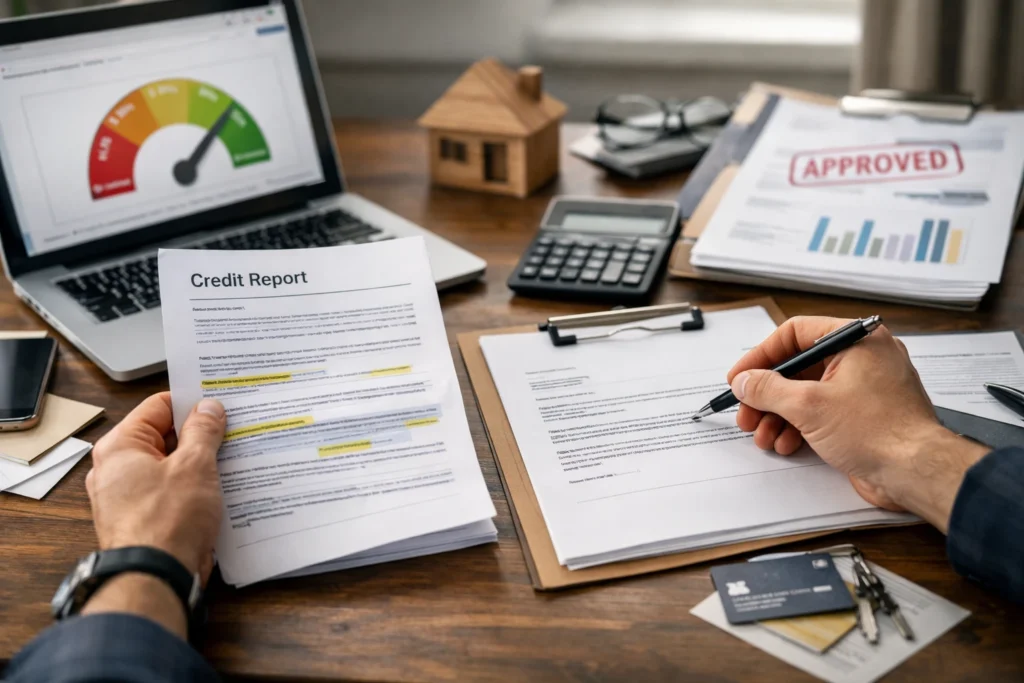
At the kitchen table, a renter circles an account they never opened on a printed credit report and starts gathering old statements, a photo ID, and a stack of envelopes. Rent is due in 12 days. The application is pending. One wrong account suddenly feels a lot bigger than a line on a page.
If you are trying to learn how to dispute credit report errors, start there — with proof, not panic. You usually do not need a paid middleman to begin. Under federal law, you can challenge inaccurate information yourself, and your first job is to identify exactly what is wrong, where it appears, and what records show the truth.
That matters because the burden often falls on you. As the University of Wisconsin financial education article notes, it is up to you to identify and dispute errors in your credit report, and credit bureaus maintain tens of millions of files, which means they are not pre-checking every account in every consumer record. Pull your reports, slow down, and build a clean file before you send anything.
Federal law also gives you the right to free annual credit reports, which you can request at AnnualCreditReport.com. Equifax also advertises a free weekly credit report for consumers, which can make follow-up easier if you need to monitor an active correction.
What should you do first when you find a credit report error?
First, confirm the mistake, collect documents that prove it is wrong, and figure out which bureau or bureaus are showing it. That sounds basic. It is also where most good disputes are won.
Watch This Helpful Video
To help you better understand how to dispute credit report errors, we’ve included this informative video from Naam Wynn. It provides valuable insights and visual demonstrations that complement the written content.
What counts as an error worth disputing?
Dispute information that is inaccurate, incomplete, or not yours. Good examples include an account opened by an identity thief, a late payment reported for a month you paid on time, the wrong balance on a credit card, a collection that belongs to someone with a similar name, or a charge-off that should show as paid or discharged.
Not every unpleasant item is an error. A legitimate 60-day late payment from 2024 is negative, but if it is accurate, a dispute will not make it disappear. The dispute process is for fixing bad data — not scrubbing truthful history.
| Error Type | Example | Useful Proof |
|---|---|---|
| Identity mistake | Wrong name variation, address, or mixed file | Photo ID, utility bill, Social Security statement |
| Account not yours | Credit card you never opened | Identity theft report, police report, written statement |
| Payment status error | Reported late, but paid on time | Bank records, statements, confirmation emails |
| Balance or limit error | $4,800 balance shown instead of $480 | Recent billing statement, lender letter |
| Collection or charge-off issue | Paid collection still shown as unpaid | Settlement letter, receipt, collector correspondence |
Do not open with a complaint letter; open with proof. The stronger your documentation, the easier it is to show the item is wrong.
What documents should you gather first?
Start with the report itself. Highlight the exact line item. Then gather only the records tied to that issue. For a mortgage late mark, that might be the servicer statement from March 2025 and the bank record showing the payment cleared. For a bogus collection, it might be the zero-balance letter and the collector’s own email.
- A copy of the credit report with the error marked
- Photo ID and proof of address
- Account statements or payment confirmations
- Letters from the lender, servicer, or collector
- Bank records or canceled checks
- Identity theft documents, if fraud is involved
Send copies, not originals. Keep a folder — digital, paper, or both — with every report, screenshot, mailing receipt, and response letter. If the issue resurfaces six months later, that file becomes your best evidence.
Who should get the dispute?
Send the dispute to every credit bureau that shows the error. If the account appears on Equifax and Experian but not TransUnion, you do not need to send the same packet to all three out of habit. You send it where the bad data lives.
You can also dispute directly with the company that supplied the information, often called the furnisher — the bank, card issuer, loan servicer, or debt collector that reported the account. In practice, I like doing both when the error is serious, especially with identity theft, a mortgage tradeline, or a stubborn collection account.
What is a credit report dispute?
A credit report dispute is a formal request asking a bureau to investigate information in your file and correct or remove it if it is inaccurate. That is the whole job. You are not asking for mercy. You are asking for accuracy.
What kinds of items can be disputed?
You can dispute personal information, account details, payment history, public-record items, collection accounts, and inquiry-related issues if they are genuinely wrong. For example, if a hard inquiry appears from a lender you never contacted, or a bankruptcy is reporting under the wrong person, that is dispute territory.
Both Equifax and Experian publish consumer-facing dispute resources. Equifax has a consumer service specifically for disputing information on an Equifax credit report, and Experian’s help content includes a dedicated page for disputing credit report information. That is a useful signal: you can start directly with the bureau rather than assuming you need a separate company.
Do you dispute with one bureau or all three?
Dispute with each bureau that shows the error. One corrected file does not automatically repair the others. If Capital One reports the same wrong late payment to Equifax, Experian, and TransUnion, each bureau may need its own dispute unless the furnisher updates them all cleanly on the next reporting cycle.
That is why many people print all three reports at once. You want to compare line by line. A mixed file problem on one report can sit next to a perfectly clean version on another.
A dispute fixes the report; a fraud alert or security freeze helps protect the report. They are related, but they are not the same tool.
Is a fraud alert the same as a dispute?
No. A dispute challenges inaccurate information. A fraud alert warns potential lenders to verify identity before opening new credit. A security freeze restricts access to your file. Equifax lists fraud alerts, active duty alerts, and security freezes as separate consumer services for exactly this reason.
| Tool | What It Does | When To Use It |
|---|---|---|
| Dispute | Asks a bureau to investigate and correct data | An account, late mark, balance, or personal detail is wrong |
| Fraud Alert | Signals lenders to verify identity | You suspect identity theft or attempted misuse |
| Security Freeze | Limits access to your credit file | You want to block new-credit misuse |
| Active Duty Alert | Adds protection for military consumers | You are deployed or on active duty |
Why does disputing an error matter?
Because wrong information can cost you money, delay approvals, or shut doors entirely. A reporting error can look tiny on paper and hit hard in real life.
How can an error affect approvals or pricing?
Inaccurate information can affect your ability to obtain an affordable loan or insurance policy, or to rent a house. That is not abstract. A lender reviewing a mortgage file may pause on a collection you do not owe. An auto lender may offer worse terms because a paid charge-off still shows an unpaid balance. A landlord may pick another applicant when your file suggests unpaid debt from 2023.
You do not need a dramatic error for real damage. One wrongly reported 30-day late payment on a current credit card can become a problem when you are trying to refinance, qualify for FHA or VA financing, or pass a tenant screening in a tight market like Phoenix or Atlanta.
A reporting error can be small on paper and expensive in real life, especially when you are applying for housing or a major loan.
Why do landlords and lenders care so much?
Because credit reports are still one of the fastest snapshots of risk they can review. Mortgage lenders, auto lenders, credit card issuers, and landlords use them to spot missed payments, high revolving balances, collections, and signs of identity confusion. They are not reading your backstory. They are reading what the file says in a few seconds.
That is why accuracy matters so much. If your report says “late,” “charged off,” or “in collections,” the next step in the process can change even if the entry is wrong.
Why should identity theft be handled quickly?
If the wrong account is tied to identity theft, the harm can keep repeating until you correct it and protect the file. A fake card opened in your name can lead to new inquiries, collection activity, address changes, and score damage across more than one bureau.
Move fast if you see accounts you do not recognize. Dispute the item, consider a fraud alert or security freeze, and use IdentityTheft.gov if you need a formal recovery path. Delay helps the bad data spread.
How do you dispute credit report errors?
You pull the report, identify the wrong item, submit supporting evidence, choose a filing method, and keep copies of everything. That is the repeatable version of how to dispute credit report errors — no tricks, no secret wording, no sweep-style nonsense.
How do you file online, by phone, or by mail?
Equifax says consumers can use an online service to do the process themselves, call for help, or mail forms for some services. Experian’s consumer content also directs people to check their reports and file disputes. Each method works. The best choice depends on how much explanation your case needs.
| Method | Best For | What To Remember |
|---|---|---|
| Online | Simple factual errors with clear documents | Fastest for most people; save screenshots and confirmation numbers |
| Phone | Basic questions or status checks | Take notes with date, time, and representative name |
| Complex cases, identity theft, mixed files, detailed paper trail | Use copies and trackable mail; keep the full packet |
- Get the report and mark the exact item.
- Write a short explanation of what is wrong.
- Attach copies of supporting proof.
- File with each bureau showing the error.
- Keep the confirmation number, mailing receipt, or both.
Dispute the same error with every bureau that shows it. One corrected file does not automatically fix the others.
What should your dispute say?
Keep it plain. Identify yourself, name the account, point to the exact error, and state what should happen next. For example: “The ABC Bank Visa account ending in 4421 is not mine. Please investigate and remove it from my file.” Or: “The March 2026 payment on my auto loan was reported 30 days late, but the attached bank record and lender statement show it was paid on March 3.”
Do not write three angry pages. Do not make legal threats unless you are prepared to follow through. And do not buy the myth that a magic phrase forces deletion. Clear facts beat dramatic language almost every time.
If a debt collector is involved and you recently received the first collection notice, remember that the Fair Debt Collection Practices Act can give you a separate 30-day window to request debt validation from the collector. That is different from the bureau dispute, but both can matter in the same case.
How do you track the result?
Under the Fair Credit Reporting Act, a bureau generally has 30 days to investigate a dispute, though that can stretch to 45 days in some situations. Save the date you filed. Then watch for an online update, mailed results, or both.
Create a tiny log. Mine usually has five lines: date filed, bureau, account disputed, proof attached, result received. When you are juggling Equifax, Experian, and a furnisher at the same time, that log keeps the process sane.
You also do not need to pay someone just to start. Under the Credit Repair Organizations Act, consumers can perform credit repair actions themselves for free. A paid service may offer convenience, but it is not a legal requirement.
What common questions come up during a dispute?
Most people ask three things right away: how long will this take, what if the bureau says the item is accurate, and what extra protection exists for fraud or military situations?
How long does a dispute take?
Usually about 30 days for the bureau investigation, with some cases reaching 45 days under FCRA rules. That is the legal investigation window, not always the moment the update appears in every lender system. If you are in the middle of a mortgage closing, plan for extra time.
Mail disputes can feel slower because delivery and document review add steps. Online filings can move faster at the front end, but speed only helps if your evidence is strong.
What if the bureau says the item is accurate?
Read the response carefully. If the bureau verified the account as accurate, ask yourself one hard question: did I actually prove the point, or did I mostly explain why I am frustrated? Many failed disputes collapse because the paperwork was thin.
If you still believe the item is wrong, you can send a new dispute with stronger evidence, dispute directly with the furnisher, and keep a copy of every response. If the process was mishandled, you can also submit a complaint through the Consumer Financial Protection Bureau. For a collection account, a direct validation request to the collector may help clarify who owns the debt and what records support it.
But accurate negative items are a different story. A real late payment usually stays. Under the FCRA, most negative information can remain for up to 7 years, while some bankruptcies can remain for up to 10 years. A dispute is not an eraser for truthful data.
What if you need identity-theft or active-duty protection?
If fraud is part of the problem, think beyond the dispute itself. Equifax lists fraud alerts, active duty alerts, security freezes, and even active duty credit monitoring as separate consumer options. Those tools protect the file while the dispute works on the bad entry.
If you are on active duty, deployed, or managing family finances from overseas, those extra protections can matter as much as the correction. The dispute repairs damage. The alert or freeze helps prevent the next round.
If you are on active duty or dealing with identity theft, separate protections like alerts or freezes may matter just as much as the dispute itself.
What should you do after you file the dispute?
Monitor all three reports, save the bureau’s response, and be ready to follow up. A correction is not final just because one email says “completed.”
How do you check whether the correction was made?
Look at the updated report, not just the summary message. You want to see whether the account was deleted, corrected, or merely commented on. If the wrong late payment was supposed to be removed, confirm the payment grid itself changed.
This is where recurring access helps. Equifax offers a free weekly credit report for consumers, which can make short-term follow-up easier. Even if you are checking one bureau more often, do not ignore the others. A fix on Tuesday at one bureau may not appear elsewhere until the next reporting cycle.
When should you escalate or re-dispute?
Escalate when the response does not match the evidence, when the same error reappears, or when another bureau still shows the bad item. Treat that as a follow-up task, not a surprise.
Good reasons to re-dispute include new proof, a clearer explanation, or a direct letter from the furnisher admitting the mistake. Good reasons to escalate include unresolved identity theft, a mixed file problem, or a bureau response that ignores the documents you actually sent. In those cases, a CFPB complaint or legal advice may be worth considering.
If the error comes back or shows up on another bureau’s report, treat it as a follow-up task, not a one-time fix.
What should you do next for your credit?
After the error is fixed, go back to the boring basics that usually matter most: pay every bill on time, keep credit card balances low relative to limits, avoid unnecessary hard inquiries, and clean up legitimate past-due debt with a plan you can sustain. Accuracy first. Habits second.
If a collection account is legitimate, a dispute is not the solution. You may need debt validation, settlement documentation, or a repayment strategy instead. If you are rebuilding from divorce, medical debt, or bankruptcy, your next best move is often steady account management for 6 to 12 months — not a flashy shortcut.
That is also why ongoing credit-file management matters. Experian’s dispute-focused consumer guidance reinforces the point: this is not always a one-and-done event. It is part of staying on top of your reports over time.
You can learn how to dispute credit report errors without becoming a credit expert overnight. Find the mistake, prove it, send it to the right place, and keep checking until the file matches reality.
Your report should tell the truth — no more, no less.
What would change for you if the next lender, landlord, or insurer saw a file that was finally accurate?
Understand Your Range With Credit Score Repair
Credit Score Repair explains score ranges, report disputes, debt recovery, and safer rebuilding for Americans facing errors, theft, mortgage, rental, low-score, or veteran credit challenges.
This content is for educational purposes only and is not legal, financial, or credit repair advice. You can dispute credit report errors yourself at no cost under federal law, and no step here guarantees any score change, approval, or deletion of accurate information.