
How to Improve Your Credit Score Fast
At 9:14 p.m., a couple sits at a kitchen table with three credit reports spread between a mortgage pre-approval letter and a stack of late notices. One page shows a card balance they thought they paid. Another lists an old address from 2018. Friday is the deadline.
That is what fast credit score improvement looks like in real life — not a magic trick, but a deadline, a clear target, and a file that needs surgery before a lender, landlord, or property manager makes a decision. If you need better terms for a mortgage, a cleaner rental screening result, or a way out of identity-theft chaos, speed comes from doing the highest-impact work first.
You do not need a CPN, a “credit sweep,” or somebody promising an overnight 100-point jump. Under the Credit Repair Organizations Act, every legitimate repair step can be done by you at no cost. What you do need is a clean reading of your reports, a plan for reported balances, and a hard stop on new late payments.
Prerequisites: Gather the right credit tools before you start your credit score improvement plan
Pull all three credit reports and compare them side by side
Watch This Helpful Video
To help you better understand credit score improvement, we’ve included this informative video from Naam Wynn. It provides valuable insights and visual demonstrations that complement the written content.
Your starting point is the same every time: get reports from Equifax, Experian, and TransUnion. You can request free copies through AnnualCreditReport.com. Do not rely on a single app score. A landlord in Dallas, a credit-card issuer, and a mortgage lender may all look at slightly different data or scoring versions.
Lay the reports next to each other. Same name? Same address history? Same employer? Same tradelines? Errors often appear on one bureau and not the others, which is exactly why you need all three.
List your due dates, balances, and any recent late payments
Next, build a one-page snapshot. Write down each open account, minimum payment, current balance, credit limit, due date, and statement closing date. If you have a Capital One card due on the 12th and a Chase card closing on the 26th, that timing matters. Reported balances can move faster than old negative marks.
Also note any recent 30-day, 60-day, or 90-day late payments. A late from last month deserves more attention than a five-year-old collection that is already scheduled to age off soon.
Set one target: mortgage, rent, debt cleanup, or fraud recovery
Pick one finish line. Not five. A mortgage file due in 45 days calls for a different plan than a renter trying to pass an apartment screening in Denver next week. Fraud recovery has different priorities than debt cleanup after a divorce.
- If your target is a mortgage, focus on reported balances, fresh lates, and unresolved disputes or fraud issues.
- If your target is renting, focus on collections, identity verification problems, and recent delinquencies.
- If your target is debt cleanup, focus on current open accounts before chasing every old item at once.
- If your target is fraud recovery, protect the file first, then clean it.
| What to Gather | Where to Get It | Why It Matters Fast |
|---|---|---|
| Three bureau reports | AnnualCreditReport.com | Shows bureau-by-bureau differences you cannot see in one app |
| Due dates and closing dates | Card and loan portals | Helps you prevent new lates and control reported balances |
| Balance and limit list | Monthly statements | Lets you spot cards hurting utilization the most |
| Deadline and goal | Your lender, landlord, or personal timeline | Keeps you from wasting time on low-impact tasks |
If you do not know exactly what is hurting your score, you cannot fix it quickly.
Step 1: Read every report line by line and flag what is actually hurting you
Check personal info, account status, balances, and payment history
Start with the simple fields most people skip. Is your name spelled correctly? Are old addresses mixed with places you never lived? Is an account marked open when it should be closed, or current when it should show paid? These details matter because bad personal data can connect you to the wrong file or confuse a manual review.
Then go line by line through each account. Look for status, balance, limit, payment history, and last-reported date. Payment history and amounts owed are major factors in many scoring models, including FICO and VantageScore. A single account incorrectly showing 30 days late can do more damage than you think.
Mark hard inquiries, collections, charge-offs, and duplicate accounts
Use different colors if you are working on paper. Yellow for hard inquiries. Red for collections. Blue for high card balances. Green for accounts in good standing. This sounds old-school. It works.
Be precise. A charge-off means a creditor moved the debt into a loss category for accounting purposes; it does not mean the balance vanished. A duplicate collection account, on the other hand, may be a reporting problem worth disputing. Do not confuse the two.
Separate reporting errors from real negatives
This is the pivot point. Some items are wrong. Some are painful but accurate. Treat them differently. If your bank app shows a score you hate, remember that the score itself is not something you dispute. The underlying report data is.
Also resist the urge to dispute every negative mark just because you dislike it. Accurate late payments usually are not removable on demand, and most negative items can remain for up to seven years. Some bankruptcies can remain for up to ten. Fast progress comes from removing inaccuracies and reducing risk, not pretending real history does not exist.
Dispute the report, not the score.
Step 2: Fix errors and fraud first, because wrong information can block fast progress
File disputes for wrong balances, dates, accounts, or late-payment marks

If a balance is wrong, the account is not yours, the date is off, or a late mark should not be there, file a dispute with the bureau showing the error. Be specific. “This account is wrong” is weak. “This account was paid and closed in March 2025, but the report shows a current balance of $842” is stronger.
Attach proof when you have it — statements, payoff letters, bank confirmations, identity documents, or correspondence from the creditor. Under the Fair Credit Reporting Act, you have the right to dispute inaccurate information. Bureaus generally have 30 days to investigate, and that window can stretch to 45 days in some cases if you submit additional relevant information during the process.
Add a fraud alert or freeze if identity theft is possible
If you see accounts you never opened, a hard inquiry from a lender you never contacted, or a new address in a city you have never visited, stop and protect the file. Add a fraud alert or place a security freeze with each bureau. These tools help reduce the risk of new fraudulent accounts being opened while you clean up the damage.
A freeze is powerful, but plan around it if you are also applying for a mortgage or apartment soon. You may need to lift it temporarily for a legitimate credit pull.
Save screenshots, letters, and confirmation numbers
Create a folder on your phone or laptop named with the month and year. Save everything there: screenshots of disputes, confirmation numbers, PDF letters, call notes, and delivery receipts. If a bureau updates one report but not the others, you will want that trail. If a lender asks why an item is under review, you will want that too.
If a collector contacts you about a debt and you are still within the 30-day validation period under the Fair Debt Collection Practices Act, request validation in writing. That is separate from a bureau dispute, and it gives you a second track for checking whether the collection data is even right.
If the file is wrong, no payoff plan can outrun bad data.
Step 3: Lower revolving utilization as fast as possible
Pay down credit cards with the highest reported balances first
When people say they want fast score movement, this is often where it happens. Revolving utilization looks at how much of your available credit you are using on cards and similar lines. If one card is near maxed out, it can hurt even if your total debt does not seem huge.
Do not automatically pay the biggest dollar balance first. Pay the card with the worst utilization first. A $900 balance on a $1,000 limit card is usually a bigger scoring problem than a $1,500 balance on a $5,000 limit card.
| Card | Limit | Balance | Utilization | Best First Move |
|---|---|---|---|---|
| Visa A | $1,000 | $900 | 90% | Priority payoff |
| Mastercard B | $5,000 | $1,500 | 30% | Secondary target |
| Store Card C | $600 | $580 | 97% | Stop use and pay down fast |
Make a second payment before the statement closing date if needed
Here is the part many people miss: credit utilization is based on the balance reported to the bureaus, often around the statement closing date, not just the due date. If your statement closes on the 28th and you pay on the 30th, the high balance may still get reported.
That is why a second payment can help. For example, you might pay part of the balance on the 14th, then make another payment on the 26th so the reported number is lower when the statement cuts.
Avoid maxing out any card while you are trying to qualify
Do not pay down a card on Monday and refill it on Thursday with moving expenses, furniture, or car repairs. If you are trying to qualify for a mortgage, an apartment, or even better insurance pricing, stability matters. Reported balances that jump around can erase the benefit of your payoff effort.
For the next one or two reporting cycles, think like an underwriter. Quiet accounts beat dramatic swings.
A lower reported balance can matter more than a bigger income.
Step 4: Bring past-due accounts current and stop new late marks
Catch up on minimum payments for any account still open
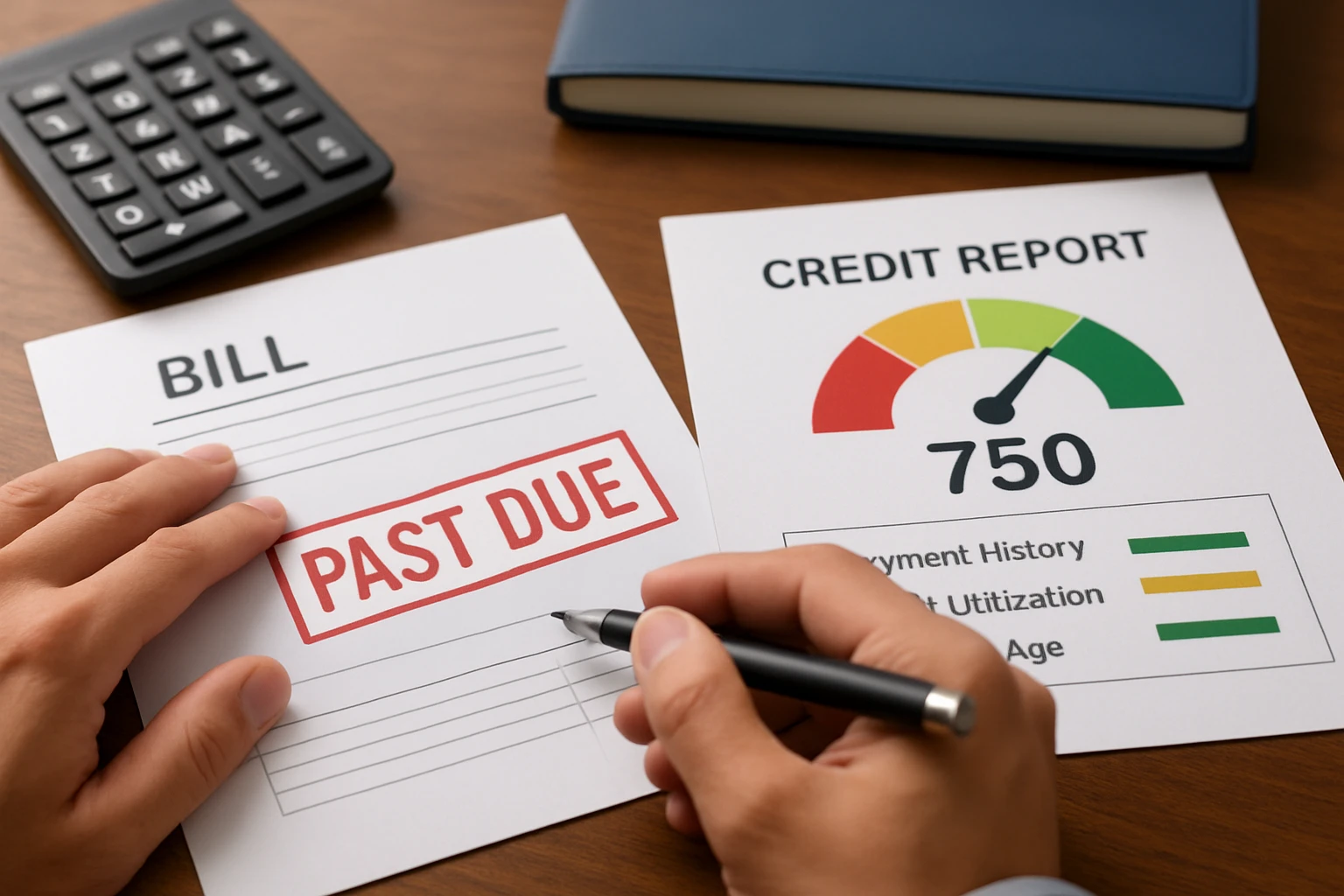
If an account is open and behind, bringing it current is urgent. One fresh delinquency can outweigh the benefit of lowering a card balance. If you have two open cards and one auto loan all hovering near 30 days late, focus there before you start obsessing over old closed accounts.
Missing payments can trigger new late marks that hurt scores and stay on reports for years. Making an account current does not erase the old late, but it stops new damage from stacking on top of it.
Ask lenders about hardship plans before skipping a payment
If cash is tight, call before the due date. Not after. Ask whether the lender offers a hardship plan, payment arrangement, or due-date change. Some creditors will work with you after job loss, military activation, medical leave, or a temporary income drop. Not all programs are scored the same, so ask how the account will be reported while you are on the plan.
If you are an eligible active-duty service member, the Servicemembers Civil Relief Act can cap interest at 6% on certain pre-service debts. That will not erase late marks, but it can free up cash flow and make it easier to stop the bleeding.
Document every agreement in writing
A phone promise is not enough. Ask for the arrangement in a secure message, email, or letter. Save confirmation numbers after every payment. If a lender says, “Pay $214 by October 22 and we will not report another late,” get that wording in writing.
This matters most when you are inside a narrow deadline — say, a VA loan file in Norfolk or a lease approval in Phoenix. You need proof, not memory.
One recent late payment can matter more than months of responsible behavior.
Step 5: Add positive history without creating new damage
Keep older accounts open when possible
Older accounts can support your average age of credit history, and revolving accounts can help your available-credit picture. That is why closing an old no-fee card just to “clean up the wallet” can backfire. If you have a 2016 card with a solid history and no annual fee, it may be doing more for you than you realize.
There are exceptions. If a card has a high annual fee, a safety issue, or repeated fraud, you may still decide to close it. Just do that with eyes open, not as an automatic move.
Use autopay for at least the minimum on every active account
Autopay is not glamorous. It is one of the best score-protection tools you have. Set autopay for at least the minimum payment on every active account, then manually pay extra where needed. That gives you a floor under your credit file.
Pair it with calendar reminders three to five days before each due date. A missed $35 minimum can cause more damage than most people expect.
Time mortgage, rental, or auto applications after the file is stable
Hard inquiries can lower scores, and opening several new accounts in a short span can make the file look riskier. If you are close to applying for a mortgage, an apartment, or auto financing, try to wait until your balances have reported lower and your open accounts are current.
That does not mean you should never open a new account. It means timing matters. One well-timed move beats three rushed applications. If you are rebuilding after a thin-file start, make sure the file is stable first, then apply with purpose.
Do not trade a temporary boost for a thinner, riskier credit file.
Common mistakes to avoid while trying to improve fast
Closing old accounts just to simplify the wallet
Closing old revolving accounts can reduce available credit and make your utilization look worse overnight. If you close two dormant cards with a combined $4,000 limit while carrying $2,000 elsewhere, you may shrink the very cushion helping your scores.
Simplicity feels good. Timing matters more. If you are inside a mortgage or rental deadline, keep the file steady until the decision is behind you.
Opening several new accounts in a short period
Too many new applications can create unnecessary hard inquiries and lower your average account age. This is where people often overreact: one blog says “open a secured card,” then they apply for four products in ten days. That is not strategy. That is noise.
Be equally skeptical of illegal or misleading shortcuts. CPNs, tradeline stunts, and “sweep” schemes are not clean, sustainable paths. Fast progress usually comes from paying the right balance, fixing the right error, and not creating fresh damage.
Ignoring collections, disputes, or fraud alerts after the first step
Many people file one dispute, feel productive, then stop checking. Do not do that. Watch for results, verify corrections, and follow up if a bureau updates one report but not the others. If identity theft is involved, keep the freeze or alert status straight while you apply for legitimate credit.
With collections, know your rights and your limits. Under the FDCPA, you can request debt validation within 30 days of an initial collection notice. You can also tell a collector in writing to stop certain communications, and collectors cannot legally harass, threaten, or repeatedly call just to annoy you. None of that makes a valid debt disappear, but it does force a cleaner process.
Also remember this plain truth: accurate negative information does not vanish because you are impatient. Most negative items follow a reporting timetable, often seven years, with some bankruptcies lasting up to ten. Precision beats panic every time.
And if a paid service tells you there is a secret button they can push, walk away. You can perform every legitimate repair action yourself for free. If you pay for help, pay for organization, education, or legal advice when needed — not for mythology.
Fast credit repair is usually about precision, not speed-hacking the system.
Fast credit score improvement comes from triage, not tricks.
Clean up report errors, lower reported card balances, bring open accounts current, and protect the history you already have. When you stop new damage, the file finally gets a chance to breathe.
If your next deadline were 30 days away, which single report issue or account balance would you attack first?
Clearer Next Steps From Credit Score Repair
Plain-English ranges, dispute guidance, fraud protection tips, and rebuilding strategies help Americans facing low scores, debt, renting hurdles, mortgage pressure, or report errors.
Educational disclaimer: This content is for educational purposes only and is not legal, tax, or financial advice. You can dispute credit report errors and handle credit repair yourself at no cost. Credit outcomes vary by lender, scoring model, bureau data, and timing. If you are dealing with identity theft, a lawsuit, or a complex reporting problem, consider speaking with a qualified attorney, a HUD-approved housing counselor, or a nonprofit credit counselor.