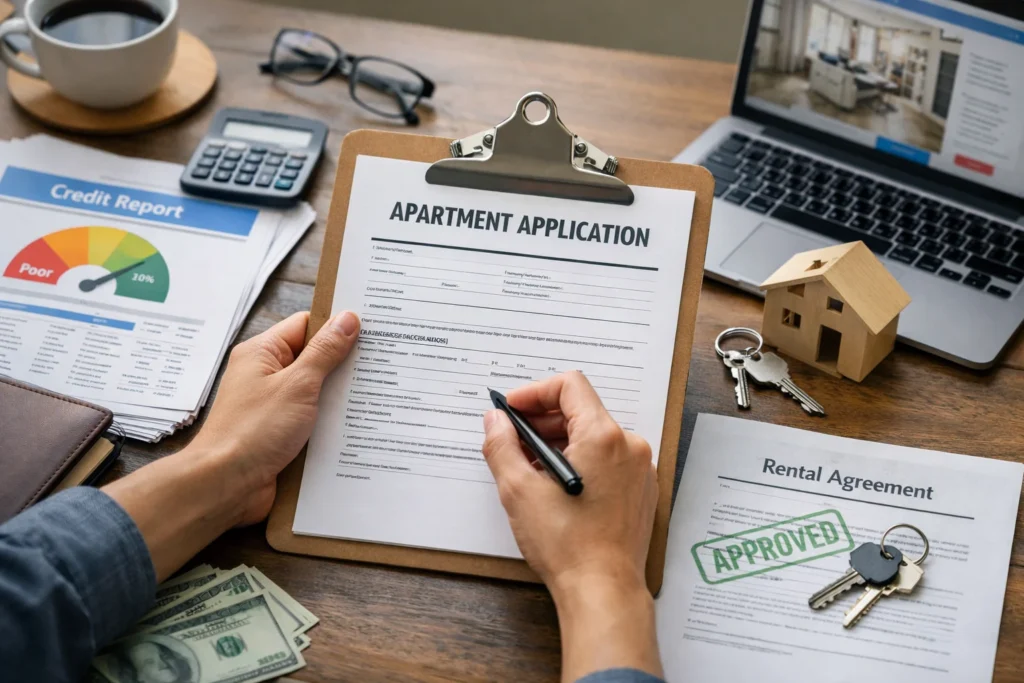
Ultimate Guide to Rent With Bad Credit
You sit across from a leasing agent with a pay stub, an old collection notice, and a rental application that suddenly feels bigger than the apartment itself.
If you are asking can i rent an apartment with bad credit, this is the moment behind the question. A weak score rarely speaks alone. Most landlords line it up beside your income, job history, prior rentals, debts, and whether you look organized enough to pay on time every month.
That is the hard part and the hopeful part. Hard, because bad credit does raise scrutiny. Hopeful, because it usually is not the only thing being judged. When you know what a landlord is really reviewing, you can stop guessing and start improving the file in front of them.
Fundamentals: What Landlords Actually See When Credit Is Bad
What a Landlord May Check on Your Report
Watch This Helpful Video
To help you better understand can i rent an apartment with bad credit, we’ve included this informative video from OfficialCoachKeem. It provides valuable insights and visual demonstrations that complement the written content.
A landlord may see more than a single three-digit number. Some screening reports show a traditional credit score. Others focus on tradelines, balances, collections, late payments, bankruptcies, or rental-related debts like unpaid utilities. A large property manager might also order an eviction search and criminal background report from a separate screening company.
eForms notes that a credit score is one metric some landlords use when evaluating tenants. That word matters: one. You may see a FICO-based number in one app and a VantageScore in another, while a landlord looks mostly at unpaid collections and recent delinquencies. There is no universal rental score.
- Recent late payments suggest current strain.
- Collections can signal unpaid obligations.
- Charge-offs tell a landlord a past account went badly.
- Bankruptcies raise questions about timing and recovery.
- Prior landlord or utility debt feels especially relevant to housing.
| What Shows Up | Why It Worries a Landlord | What You Can Show Instead |
|---|---|---|
| Old paid collection | Past repayment trouble | Proof it was paid and newer on-time accounts |
| Recent 60-day late payment | Current instability | Steady income, savings, and an explanation |
| Unpaid utility or landlord debt | Direct rental risk | Settlement proof or a payment plan |
| Bankruptcy | Questions about recovery timeline | Post-bankruptcy clean payment history and reserves |
Why a Bad Score Is Not an Automatic No
Bad credit can trigger caution, but it does not automatically end the search. We have seen applicants with lower scores approved because their income was stable, their prior landlord gave a strong reference, and their paperwork was clean. We have also seen people with decent scores rejected because they carried recent rental debt. Context wins more often than people think.
eForms cites a November 2019 YouGov survey conducted by ScoreSense that found 53% of Americans had been rejected for a credit card, loan, or car because of poor credit. If that sounds familiar, you are not unusual. You are dealing with a common screening flag, not a personal verdict.
Bad credit is a screening flag, not a verdict.
Landlords want to answer a simple question: will you pay on time and take care of the unit? A medical collection from 2022 and two years of perfect rent payments tell a different story than five recent missed card payments and an unpaid electric bill from last month.
How Rent-to-Income Fits Into the Decision
Even if your credit is rough, affordability can rescue the application. Go Clean Credit says staying within your affordability range matters, and renters spending around 35% of annual income are considered in that range. In practice, standards vary. Some landlords want gross monthly income equal to three times the rent, while others use a looser or tighter formula.
Run the math before you fall in love with a place. If you earn $60,000 a year, 35% works out to about $21,000 a year in rent, or roughly $1,750 a month. If the apartment is $2,150, the landlord may worry that your score and your budget are both stretched. If it is $1,550, your file instantly looks more stable.
That does not mean you should only chase the cheapest listing on Zillow or Apartments.com. It means you should target homes where the numbers support your story.
How Apartment Screening Works When You Ask: Can I Rent an Apartment With Bad Credit?
What Gets Reviewed After You Apply
After you apply, the process usually moves fast. In a competitive market, some decisions come back the same day. Here is what usually gets checked:
- Your application details, including addresses, income, and employer.
- Your identity, often through your Social Security number and photo ID.
- Your credit report or tenant screening report.
- Your rental history, including prior landlord references or eviction records.
- Your background report, if the property screens for it.
Rentberry’s overview gets one thing right: renting with a bad score is difficult because landlords want evidence of financial stability. That means the credit pull is only one part of a bigger file. If your application shows frequent job changes, vague income, or incomplete addresses, weak credit starts to look worse.
Why Some Landlords Are More Flexible Than Others
Large property managers often run rigid screening rules. A software setting may reject applications below a certain score or flag unresolved collections automatically. A small landlord with a duplex in Columbus or Phoenix can still say, “Tell me what happened.” That human judgment matters.
Go Clean Credit points readers toward properties listed for rent by owner, and that advice tracks with real-world outcomes. Individual landlords and small rental companies often care more about your full story than a single number. They may look harder at your current income, savings, references, and whether you show up prepared.
Smaller landlords often care more about the whole story than one score.
This is why two applications can end differently. A corporate complex may decline you in 10 minutes. A landlord renting out a basement apartment or a four-unit building may approve you after reviewing your pay stubs and hearing a clear explanation for an old charge-off.
What Happens After the Credit Pull
Once the report comes back, you usually get one of three outcomes: approved, conditionally approved, or denied. Conditional approval might mean a larger deposit where state law allows it, a co-signer, proof of reserves, or extra references. It is not the same as rejection.
If you are denied based on a consumer report, ask for the adverse action notice. Under the Fair Credit Reporting Act, that notice should identify the reporting company used in the decision. That gives you a direct trail back to the report so you can review it for errors or outdated negative items.
Do not treat the credit pull as the end. eForms makes a fair point: finding a great home without great credit is possible. Your job is to learn which part of the file actually caused the concern and fix that part before the next application.
Best Practices That Improve Your Odds Before You Apply
Review and Dispute Errors First

Check your reports before a landlord does. Go Clean Credit recommends reviewing your credit report often and disputing errors before landlords see them. Start with your free reports at AnnualCreditReport.com, then compare all three bureaus line by line.
Look for accounts that are not yours, duplicate collections, wrong balances, wrong dates, or outdated negative items. Under the FCRA, credit bureaus generally have 30 days to investigate a dispute, and some situations can stretch to 45 days if you send additional information during the process. Most negative information falls off after seven years, while some bankruptcies can remain for up to 10 years.
If a collector just contacted you about a debt, the FDCPA gives you a 30-day window to request validation after the initial notice. That is different from a credit bureau dispute, but it can help you sort out whether the debt is accurate before you explain it to a landlord.
Fix what you can prove, and explain what you cannot.
Keep copies of every letter, upload, and response. If a collection gets deleted, print the confirmation. If it stays, be ready to explain the timeline briefly and honestly.
Strengthen Income and Affordability
Bad credit hurts less when the rest of the numbers look calm. Keep your target rent within a range you can defend. Go Clean Credit’s affordability guidance centers on about 35% of annual income, though some landlords will still use stricter rules. If your gross monthly pay is $4,800, a $1,350 unit reads very differently from a $1,950 one.
Build the income side of the story with documents, not promises. Bring recent pay stubs, the last two or three bank statements, an offer letter if you just started a job, and proof of any regular side income. If you have cash reserves, show them. A landlord does not need to guess at stability when you put it on paper.
If your balances are high on revolving cards, paying them down can help your profile over time, though it will not erase accurate collections overnight. Focus first on the items that shape rental risk most clearly: recent delinquencies, unpaid housing-related debts, and affordability.
Use Support From a Co-Signer or Stronger References
A co-signer or guarantor can change the conversation. Reference Article 3 specifically recommends finding a co-signer, and many landlords will accept one when the applicant has enough income but a thin or damaged file. Requirements vary. Some want the guarantor to show stronger credit and higher income than the tenant.
Strong references matter too. A short letter from a prior landlord stating that you paid on time for 24 months can carry real weight. So can a note from an employer confirming stable hours. If you are new to credit or rebuilding after divorce, medical debt, or a layoff, those references help separate your present from your past.
Do not ignore nontraditional housing opportunities. A room rental, a sublet, a month-to-month arrangement, or a smaller owner-managed building can buy you six to 12 months of clean history while you repair the underlying credit issues.
Common Mistakes That Sink Rental Applications
Waiting Until After Denial to Check Your Report
This is the most common avoidable mistake. If there are errors on your report, dispute them before the landlord sees them. A wrong collection from 2021 can cost you the same unit as a real one if you discover it too late.
Identity theft makes this worse. If you ever dealt with a breach issue such as Equifax or saw an unfamiliar account open in your name, freeze your credit files and document everything. A landlord may not wait for you to sort it out after a denial arrives.
Ignoring Affordability Math
Bad credit and an overextended budget make each other look worse. If your debt payments already eat up most of your monthly cash flow, a landlord may see risk even if your score is not terrible. eForms cites the same YouGov survey from ScoreSense noting that 25% of both Millennials and Gen-Xers carry more than $4,000 in debt each month. That kind of burden makes rent shocks harder to absorb.
You do not need a perfect debt-to-income ratio to rent. You do need believable math. Choosing a unit that leaves room for utilities, transportation, and groceries shows judgment — and landlords notice judgment.
Submitting an Unprepared Application
Hot markets punish sloppy files. Reference Article 3 frames renting in a hot market as especially difficult, and that matches what happens on the ground: owners move to the next applicant fast. Missing pay stubs, half-finished applications, vague job dates, and no explanation letter can sink you even before credit becomes the main issue.
Panic also pushes people toward shortcuts. Do not buy a CPN. Do not fall for a “credit sweep” claim that promises to erase accurate negative items by magic. Under the Credit Repair Organizations Act, consumers can perform every repair action themselves for free, and no legitimate educator should promise guaranteed approval or a fixed point increase.
Don’t apply with a story and no paperwork.
If you need the landlord to overlook a weak score, you must make it easy for them to say yes.
Tools and Resources to Use Before You Apply
Credit Reports and Dispute Tools

Start with your reports, then build a repair plan. The Consumer Financial Protection Bureau’s guide to rebuilding credit is a practical place to review the basics. If you want a plain-English overview of repair steps, Experian’s explanation of how to repair credit and Bankrate’s primer on credit scores help you sort out scoring, reporting, and realistic timelines.
Go Clean Credit also points readers toward understanding what makes up a FICO score and issues tied to events like the Equifax data breach. That is useful because not every problem is “bad habits.” Sometimes it is thin history. Sometimes it is identity theft. Sometimes it is a stale collection that should have aged off already.
Skip any company that promises a miracle. Legal, sustainable repair means reviewing the report, disputing inaccuracies, validating questionable debts when appropriate, and adding positive history over time. If you want extra guidance, Credit Score Repair publishes educational material built around those basics rather than guarantees.
Documents to Build a Renter Packet
A strong renter packet can do for housing what a resume does for jobs. It reduces uncertainty. Instead of letting the landlord imagine risk, you hand them proof of stability.
| Document | Why It Helps | Priority |
|---|---|---|
| Photo ID | Confirms identity quickly | Essential |
| Recent pay stubs | Shows current income | Essential |
| Bank statements | Shows cash flow and reserves | High |
| Employment letter | Supports job stability | High |
| Prior landlord reference | Confirms payment behavior | High |
| Brief explanation letter | Gives context for negative marks | Helpful |
| Dispute results or paid collection proof | Shows active cleanup | Helpful |
| Co-signer information | Reduces landlord risk | If needed |
A strong renter packet can do for housing what a resume does for jobs.
Keep it simple. One folder. One PDF if you are applying online. Label documents clearly so the landlord does not have to hunt.
Where to Look for More Flexible Rentals
If your credit is weak, search strategy matters as much as repair strategy. Reference Article 4 recommends for-rent-by-owner properties, and Reference Article 3 highlights small rental companies and individual landlords. Both are practical leads because they often allow room for explanation.
That does not mean every owner-managed listing is easy. Some will still be strict. Some will be scams. Verify ownership, never wire money before touring, and read the lease carefully. But compared with a large complex running dozens of applications through an automated filter, a duplex owner may actually read your packet.
Also keep backup lanes open: room shares, sublets, older buildings, accessory dwelling units, or a temporary month-to-month place while you clean up disputes. Flexibility is not failure. It is strategy.
Conclusion: Turn a Bad-Credit Search Into a Plan You Can Execute
Decide Whether to Apply Now or Repair First
Do not apply blindly. If your main issue is one old paid collection, steady income, and solid references, applying now may make sense. If your report shows fresh late payments, unresolved errors, identity theft, or an unpaid landlord debt, spend 30 to 45 days fixing the file first and let the FCRA dispute process work.
| Apply Now If… | Repair First If… |
|---|---|
| You can document stable income and affordable rent | Your target rent already strains your budget |
| Your negative items are older and explained | You have recent delinquencies or active collections |
| You have strong references or a co-signer | You found clear report errors that need investigation |
| You found a flexible owner-managed property | You are only applying to rigid corporate buildings |
Choose the Right Properties and Backup Options
Point your applications where they can breathe. Aim for apartments or houses within a believable budget — Go Clean Credit centers affordability around roughly 35% of annual income — and prioritize landlords who still weigh the whole file. Keep a backup list of room rentals, sublets, and smaller owner-managed buildings so you are not forced into a desperate yes.
If you can show income, stability, and honesty, bad credit becomes one factor—not the whole decision.
Reapply Only When Your File Is Stronger
Reapply after something real has changed: a dispute result came back, a collection was paid or corrected, your savings grew, your references improved, or you found a better-fit property. Reference Article 3 is right on the core point: finding a great home without great credit is possible. It just usually happens after a targeted reset, not after five rushed applications in a row.
Bad credit makes renting harder, not hopeless.
Check your report, control your budget, target flexible landlords, and bring proof instead of promises. If you came here asking can i rent an apartment with bad credit, you now have a plan instead of a guess. What would make your next application feel stronger 30 days from now?
Build Rental Confidence With Credit Score Repair
Credit Score Repair gives plain-English basics, range explanations, dispute guidance, debt recovery help, and rebuilding steps for Americans facing rental denials or report errors.
This content is for educational purposes only and is not legal, financial, or housing advice. Nothing here guarantees apartment approval, credit-score increases, or the removal of accurate information from your credit reports.
Under the Credit Repair Organizations Act, you can perform credit-repair actions on your own for free. Federal rights under the FCRA and FDCPA, along with landlord-tenant rules, can vary by situation and location. If you need advice about a specific denial, lease, debt, or dispute, speak with a qualified attorney or HUD-approved housing counselor.
Generated on SEOPro AI