How to Dispute Errors on Your Credit Report Fast
You are two weeks from a mortgage application when you spot a 30-day late payment on your credit report that belongs to someone else. One line. Real damage. If it stays there, a lender may price your loan off bad data — or stop the file cold until the issue is explained.
That is exactly when learning how to dispute errors on your credit report stops feeling optional. Fast does not mean careless. The quickest disputes usually come from a clean folder, a precise explanation, and proof that an investigator at Experian, Equifax, or TransUnion can review without guessing what you mean.
You can dispute inaccurate information yourself at no cost, and the Fair Credit Reporting Act gives credit bureaus a general 30-day window to investigate, with up to 45 days in some cases. Your job is simple: find the wrong line, prove the problem, send the dispute to the right place, and keep a paper trail until the item is corrected or removed.
Prerequisites and Tools for How to Dispute Errors on Your Credit Report
The fastest disputes begin with complete documentation, not a rushed complaint sent from your phone while you are standing in line at Target.
Pull all three credit reports
Start with all three bureaus: Experian, Equifax, and TransUnion. They can show different balances, payment histories, collection accounts, or even different versions of the same loan. A medical collection might appear on one file and not the other two. A duplicate auto loan entry might hit only Equifax.
That difference matters because you cannot assume one dispute fixes every report. Many consumers start by getting their files from AnnualCreditReport.com, the federally authorized source for free reports. Save a PDF or print each file so you have a dated copy of what you saw.
Create a simple dispute folder
Keep one folder for everything. Physical, digital, or both. Label documents by bureau and account so you can find them in seconds. “EQ_ABCCollections_Duplicate_2026” is better than “credit stuff.”
| Tool | Why It Helps | Example |
|---|---|---|
| All three credit reports | Errors may show on only one bureau | TransUnion shows a collection that Experian does not |
| Proof documents | Gives the investigator something concrete to verify | Bank record, billing statement, payoff letter, lease |
| Tracking log | Keeps deadlines and follow-ups organized | Date filed, bureau, account, confirmation number |
| Paper-trail record | Shows exactly what you sent and when | Screenshot, PDF, USPS tracking, certified mail receipt |
A solid folder usually includes the reports, your dispute letters or screenshots, supporting documents, mailing receipts, confirmation emails, and every response you receive. Keep copies of supporting documents and avoid mailing originals when possible.
Decide whether this is an error or identity theft
A wrong late-payment date is one kind of dispute. An account you never opened is another. If the account is not yours at all, you may be dealing with identity theft, a mixed file, or a reporting match error involving someone with a similar name or Social Security number.
That distinction changes your next move. Identity-theft disputes are usually stronger when backed by an FTC Identity Theft Report and, when appropriate, a police report. You may also want a fraud alert or credit freeze if new accounts are appearing.
Rule of thumb: if you cannot prove it in one folder, you are not ready to dispute it yet.
Step 1: Identify Every Error and Match It to the Right Bureau
You cannot fix what you have not pinpointed. Each problem needs its own label, its own proof, and the name of the bureau where it appears.
Highlight the exact line that is wrong
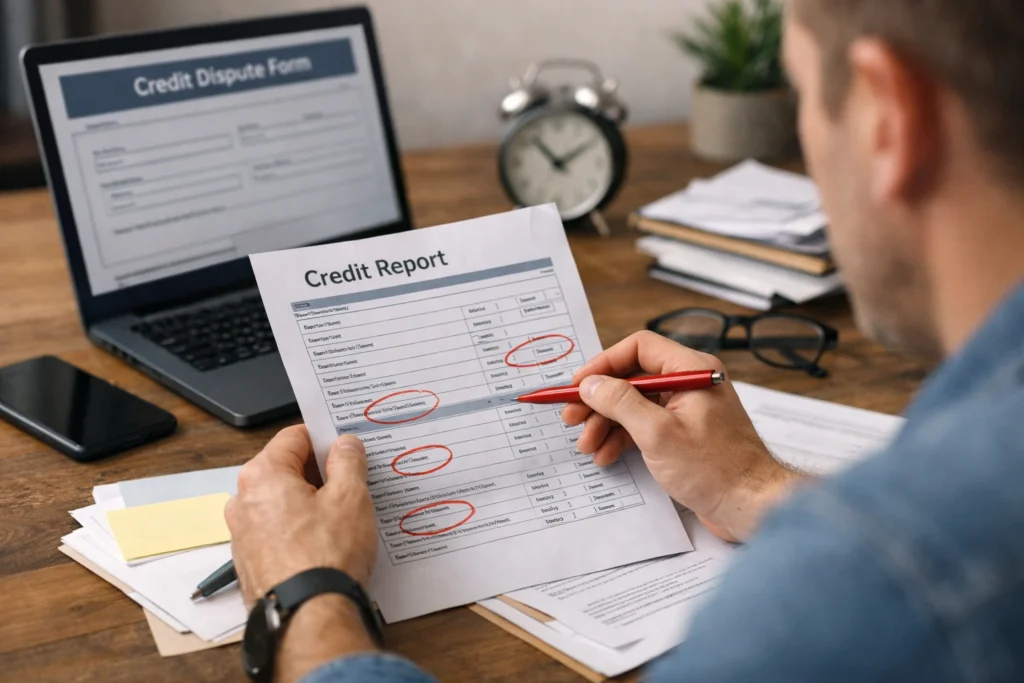
Do not say, “My report has mistakes.” Say exactly what is wrong. Circle or highlight the line item and name the field that needs to change.
- Wrong balance
- Incorrect payment status
- Late payment that never happened
- Account owner listed incorrectly
- Duplicate collection listing
- Wrong date opened or date of first delinquency
For example, if a Chase card shows a 60-day late payment in March 2026 but your bank statement shows automatic payment cleared on March 12, that is a specific dispute. If a collection from Midland Credit Management appears twice with the same amount and original creditor, that is another specific dispute.
Note which bureau shows the mistake
Create a short list. You can use a notepad, spreadsheet, or the notes app on your phone. The point is to match the error to the bureau before you file.
A single account can be wrong on Experian and correct on Equifax. Or it may appear only on TransUnion. Handle each bureau separately, even when the account name is the same. That keeps your disputes cleaner and easier to track.
Separate factual errors from accurate negative items
This part trips people up. Some items are painful but accurate. If you really paid 45 days late on a Discover card last year, you usually cannot remove that mark just because it hurts your score. Disputes are for inaccurate, incomplete, or unverifiable information — not for facts you wish were different.
Also keep timing in perspective. Most negative information can stay on a credit report for up to seven years, and some bankruptcies can stay for up to 10 years. If an item is accurate but too old, that is an obsolescence problem. If it is current and accurate, your path is rebuilding, not disputing.
Do not write one giant dispute for ten problems; separate errors are easier to verify and faster to fix.
Step 2: Collect Documents That Prove the Mistake

The bureau moves faster when your dispute packet clearly shows what should change and why. Think like a busy reviewer. If the proof is obvious, your odds improve.
Use statements, bills, and letters as proof
Strong proof depends on the issue. A wrong balance may call for a recent statement or payoff letter. A fake late payment may call for payment confirmations, bank records, or servicer letters. A wrong address may call for a lease or utility bill.
Useful documents often include:
- Billing statements
- Bank records or canceled payments
- Account letters from the lender
- Lease papers or utility records
- Settlement or payoff confirmations
- Collection notices that conflict with the report
Add theft documents if the account is not yours
If the account does not belong to you, say that plainly and back it with identity-theft paperwork. A generic note that says “not mine” is weak. An FTC Identity Theft Report, copy of your ID, and supporting documents are much stronger. When it fits the situation, a police report can add weight.
If a collector is involved and you are still within 30 days of the first written collection notice, you may also have separate validation rights under the Fair Debt Collection Practices Act. That process is different from a bureau dispute, but it can support the same goal: forcing the record to match reality.
Make clean copies and keep a complete backup
Send crisp, readable copies. Blurry screenshots, cut-off mobile photos, and handwritten explanations on random paper slow everything down. If you upload online, save the file exactly as submitted. If you mail it, keep a full duplicate packet at home.
A good test is brutal but useful: would a stranger understand your proof in 30 seconds? If not, tighten it up before you file.
If your proof would not convince a stranger in 30 seconds, gather better proof.
Step 3: File the Dispute With the Bureau and the Furnisher
To move quickly, send the dispute to the place where the error lives and, when useful, to the company that reported it. That company is often called the furnisher — a lender, card issuer, servicer, or collection agency.
Dispute with each credit bureau separately
If the same error appears on Experian, Equifax, and TransUnion, you generally need three disputes. Keep the facts consistent, but tailor the filing to the report where the item appears. Include the account name, partial account number if shown, the exact field that is wrong, and the correction you want.
Your request does not need drama. It needs precision. A plain sentence like this works better than a two-page rant: “Please investigate ABC Bank account ending 4821. Equifax shows a 30-day late payment for April 2026. My attached bank statement and payment confirmation show the payment posted on April 8, 2026. Please correct the payment history.”
Send the same facts to the lender or collection agency
If the wrong data came from a creditor or collector, send them the same core facts and proof. That matters because the furnisher is often the source the bureau checks during the investigation. If the lender updates its records quickly, the bureau correction may follow more smoothly.
Collection accounts deserve extra care. If the amount is wrong, the dates are off, or the debt is not yours, send the bureau dispute and the collector dispute separately. Keep your message factual. Ask for investigation, validation when applicable, and correction of inaccurate reporting.
Choose the submission method that gives you a paper trail
Online disputes are usually the fastest to submit. Mailed disputes often create the best record. Phone disputes are the weakest starting point because your documentation is thinner unless you follow up in writing.
| Method | Speed To File | Paper Trail | Best Use |
|---|---|---|---|
| Online | Fastest | Good if you save screenshots and emails | Simple factual disputes with clean uploads |
| Slower to send | Strongest with tracking or certified mail | Complex cases, identity theft, larger proof packets | |
| Phone | Immediate | Weak unless confirmed in writing | Status checks, not your first choice for filing |
If you mail, use a method that creates a receipt. If you file online, save every confirmation page before you close the browser tab.
Speed is good, but proof is better; the best filing method is the one you can document later.
Step 4: Track Deadlines and Save Every Response

Your dispute does not end when you click submit. The calendar controls your next move.
Record the date and confirmation number
Log the day you filed, where you filed, what account you disputed, and the confirmation number or mailing receipt. A cheap spiral notebook works. A spreadsheet works better. What matters is that you can prove when the clock started.
If you are juggling a rental application, a mortgage rate lock, and two collection errors at once, this log becomes your command center.
Watch the investigation window
Under the Fair Credit Reporting Act, credit bureaus generally have 30 days to investigate a dispute. In some situations, that window can stretch to 45 days. Mark both dates on your calendar now, not later.
That timeline is why vague filings waste time. A weak dispute burns the same clock as a strong one. If your case is time-sensitive — for example, a home purchase in Phoenix or a new apartment in Atlanta — you want the first filing to be sharp.
Save letters, emails, and screenshots
Keep every response: mailed letters, portal messages, PDFs, email confirmations, and screenshots of status pages. If the bureau says the item was “verified,” save that too. You may need it for reinvestigation or escalation.
Many people lose momentum here. They remember filing. They cannot prove what they sent, when they sent it, or what the bureau said back. Do not put yourself in that position.
Treat the dispute like a mini case file: date it, label it, and keep everything.
Step 5: Review the Outcome and Escalate if the Error Remains
A finished dispute is only a win if the report is actually corrected, deleted, or updated. Do not stop at “case closed.” Read the report again.
Check the revised credit report line by line
When the investigation ends, compare the updated report to the original. Look at the exact account, the exact field, and the exact wording. Was the late payment removed? Was the balance fixed? Was the duplicate account deleted, or did one version linger?
Focus on the data first, not just the score. Your score may shift after the data changes, but the real goal is an accurate report. If you are preparing for a mortgage, auto loan, or apartment screening, accurate data is the immediate priority.
Ask for reinvestigation if new evidence exists
If the item stays wrong and you have stronger proof now, send a tighter packet and request another review. Maybe your first dispute used a bank screenshot, and now you have a full statement plus a letter from the creditor. That is worth resubmitting.
Keep the second round focused. Reference the prior dispute date, include the confirmation number, and point to the new evidence. Do not just repeat the same unsupported complaint louder.
Escalate when the bureau verifies something you can disprove
“Verified” does not always mean “correct.” It can mean the bureau checked the furnisher and got the same wrong answer back. If your evidence still wins, escalate. Options can include disputing directly again with the furnisher, filing a complaint with the Consumer Financial Protection Bureau, or speaking with a qualified consumer law attorney if the stakes are serious.
You can also ask to add a consumer statement in some situations, but that is not the same as a correction. A statement may explain the issue. It does not clean up bad data by itself. If the line is still inaccurate, keep pressing for the line to change.
Do not confuse “verified” with “correct”; if the evidence is still on your side, escalate instead of giving up.
Common Mistakes That Slow Down Credit Report Disputes
Most delays come from vague claims, weak evidence, or sending the wrong message to the wrong place. These are the traps I see over and over.
Filing one vague complaint for multiple problems
“Please fix everything on my report” is not a real dispute. It is a frustration dump. Broad, unclear complaints are harder to investigate quickly because the reviewer has to guess what you want corrected.
Break the work apart. One error, one proof packet, one clear request. If three bureaus show three different versions of the same collection, treat them as separate cases.
Sending unreadable copies or original documents
Unreadable proof slows you down. Original proof can disappear. Neither helps. If you are mailing a payoff letter from Wells Fargo or a payment history from your student-loan servicer, send a clean copy and keep the original in your folder.
The same rule applies online. Full-page PDFs beat cropped photos. If a screenshot cuts off the account number, statement date, or payment posting date, redo it.
Disputing accurate negative information as if it were an error
Accurate late payments, charge-offs, and collections usually will not vanish because they are inconvenient. That is why quick-fix schemes sound so tempting — and so often turn ugly. Be skeptical of CPN pitches, “609 sweep” promises, or anyone claiming they can erase truthful data overnight.
If the item is accurate, your better move is to work on the underlying debt, age-off timelines, or positive rebuilding steps. Disputes are powerful when the information is wrong. They are weak when the information is simply painful.
Fast disputes are precise disputes: one error, one proof packet, one clear request.
The fastest path is a clean paper trail, one error at a time, until the bureau fixes or deletes the inaccurate item.
If you have been putting off how to dispute errors on your credit report, start with the line that can hurt you first — the false late payment before a mortgage, the duplicate collection before an apartment search, or the account tied to identity theft.
What is the first item on your report that you can prove is wrong today?
Steady Credit Progress With Credit Score Repair
Get plain-English score-range basics, dispute steps, comparison content, and rebuilding strategies for Americans facing report mistakes, debt, renting issues, mortgage pressure, or identity theft.
This page is for educational purposes only and is not legal, tax, or financial advice. You can dispute credit report errors yourself for free under federal law. If your situation involves identity theft, debt collection, mortgage denial, or possible legal violations, consider speaking with a qualified attorney, a HUD-approved housing counselor, or a nonprofit credit counselor before you act.