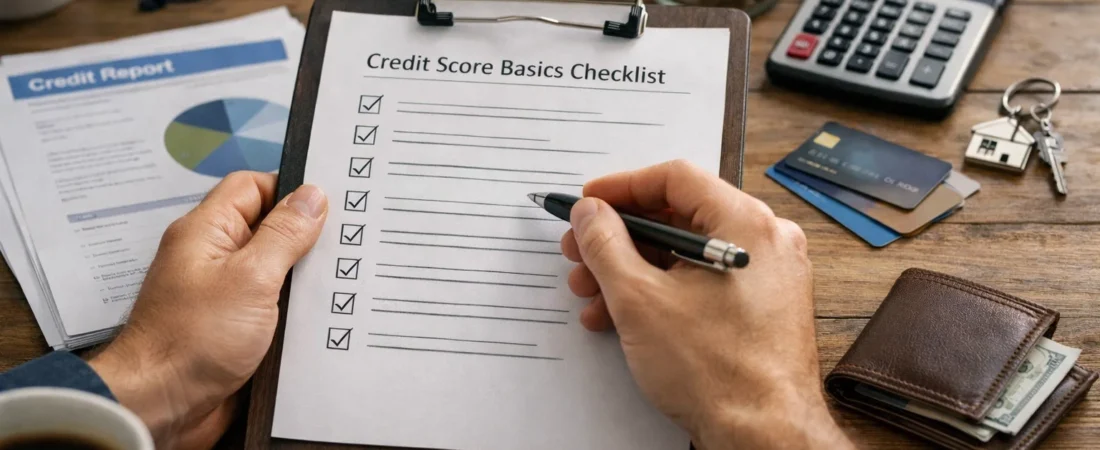
The Credit Score Basics Checklist
At the kitchen table, you circle an old address on a credit report, open a notebook, and write three lines: wrong address, unknown inquiry, card balance at 82%. That is where credit score basics stop being theory. You are no longer staring at a scary number. You are sorting evidence.
Most consumer credit scores are built from information in your credit reports, not from income, not from guesswork, and not from whatever a friend swears worked in 2023. If you are trying to qualify for a mortgage in 90 days, rent an apartment in Phoenix next month, or recover from identity theft, sequence matters. A written plan keeps you from fixing the wrong thing first.
You will also see more than one score in the wild. FICO and VantageScore are the two names most people hear, yet a lender, landlord, or card issuer may rely on a different version than the one shown in a free monitoring app. That mismatch is why so many people feel stuck. They watch one number while the decision-maker checks another.
Pre-work checklist for credit score basics
Do the sorting before you start paying, disputing, or applying. This stage feels slow. It saves weeks.
Watch This Helpful Video
To help you better understand credit score basics, we’ve included this informative video from Mashable. It provides valuable insights and visual demonstrations that complement the written content.
Start with the credit score basics checklist before you chase a number
Define the score you actually need to improve. If your goal is a conventional mortgage, the score that matters may not be the same one you see from your bank on a Sunday morning. If your goal is a new rewards card, the issuer may care more about recent inquiries, existing limits, and internal approval rules than the headline number alone.
Separate your credit score from your credit report. Your score is a snapshot created by a scoring model. Your report is the raw file from Equifax, Experian, or TransUnion — names, addresses, account history, balances, inquiries, and public-record data where applicable. Scores move when that underlying data changes. For plain-English background, Bankrate’s overview of credit scores and Experian’s repair guide both point back to the same reality: data drives the result.
- Name one immediate goal: mortgage preapproval, apartment approval, auto refinance, debt cleanup, or first credit card.
- Write down the score source you are looking at, such as a FICO score from a card issuer or a VantageScore from a monitoring app.
- Record one baseline number with one date. “642 on October 5” is useful. “Somewhere in the low 600s” is not.
- Note any near-term deadline, such as a lease renewal in 45 days or a lender appointment next month.
| What You Are Looking At | What It Means | Why It Matters |
|---|---|---|
| Credit score | A numerical snapshot from a model such as FICO or VantageScore | Helps you track direction, but does not tell you which line item is wrong |
| Credit report | The underlying account and identity data from a bureau | Gives you the facts to verify, dispute, correct, or pay down |
| Score version tied to a goal | The model a lender, landlord, or issuer is likely to review | Keeps you from solving for the wrong audience |
Rule of thumb: do not try to fix your score until you know which report and which goal you are working on.
Set one baseline before making changes. If you pay three cards, dispute two accounts, and open a new secured card in the same week, you will not know what actually helped. We see this all the time with borrowers who are preparing for FHA or VA financing. They do a little of everything, then cannot explain the outcome to the loan officer.
Pull the right reports and verify every detail first
Get reports from all three major bureaus: Equifax, Experian, and TransUnion. Do not assume one report tells the whole story. A collection account may appear on only one bureau. An old address may show on two. A hard inquiry from a retailer in Ohio may be present on TransUnion and nowhere else.
Federal law gives you the right to free annual reports, and the CFPB’s rebuilding guidance is a useful starting point if you need a consumer-rights refresher. Once you have the reports, verify the personal data first: name variations, current and former addresses, Social Security number fragments, employers, and account ownership details. Wrong identity data can create a mixed file or make a valid dispute harder to win.
- Check every address, especially unfamiliar apartments, old military bases, or places where you never lived.
- Match every open and closed account to your own records.
- Flag unfamiliar hard inquiries, especially if they line up with no application you made.
- Mark duplicate accounts, incorrect balances, wrong dates, and accounts that belong to someone else.
- Pull out any sign of identity theft before you start debating balances or due dates.
Identity theft often shows up first in small clues: an address you do not recognize, a cell-phone account you never opened, or a department-store inquiry from a state you have never visited. A wrong middle initial will not always affect scoring, but it can signal a sloppy or mixed file. An unfamiliar account absolutely can.
If the identity data is wrong, fix that before you argue about balances or late payments.
Execution checklist
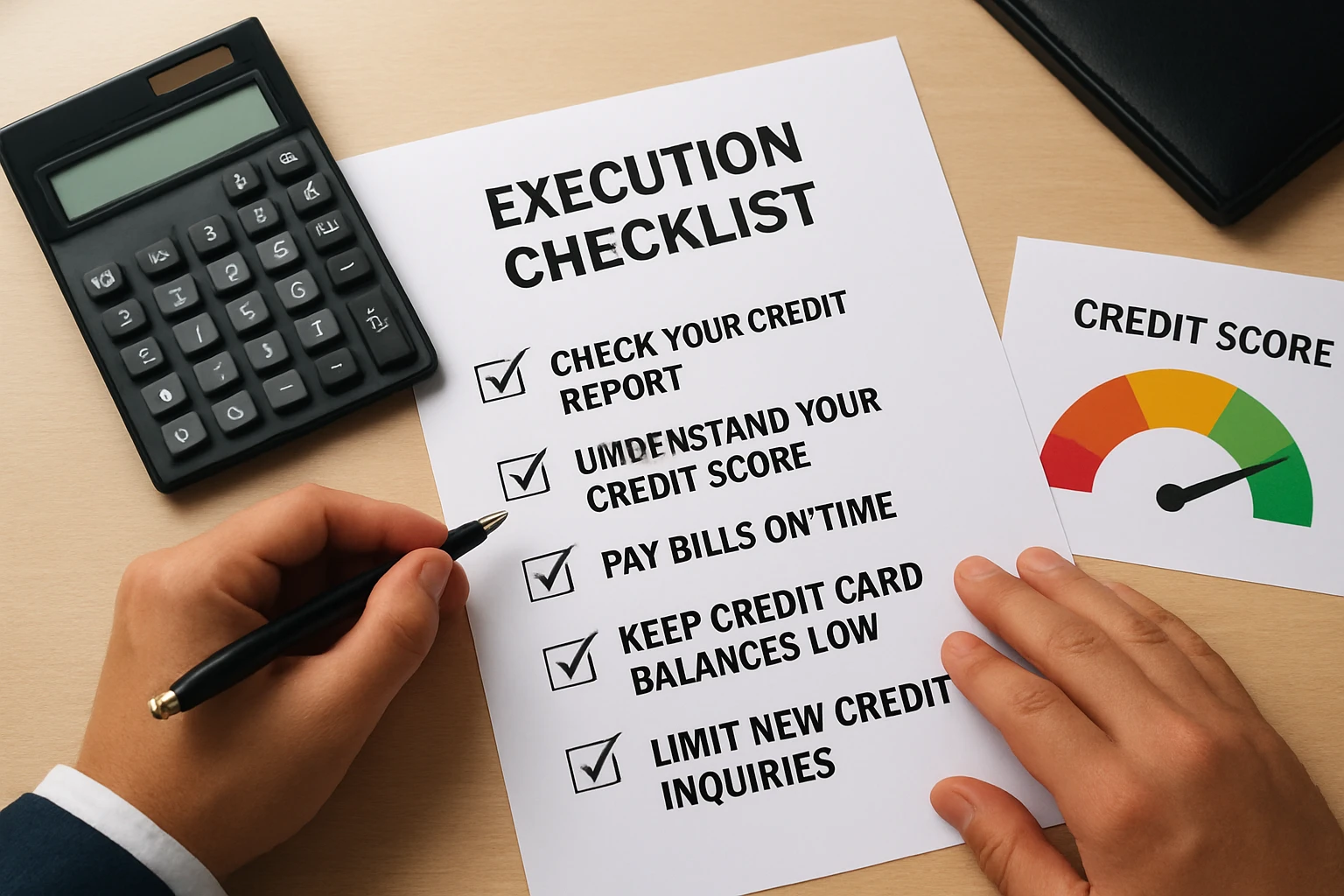
Now move to the highest-impact actions first. This part is less glamorous than online credit myths. It works better.
Make every payment on time going forward
Payment history is one of the most influential factors in many scoring models. That means the next 30, 60, and 90 days matter. Even if old lates are already sitting on the report, you can stop new damage today. Set autopay for at least the minimum where cash flow allows. If autopay makes you nervous, set calendar reminders five days before the due date and again one day before.
If you are already behind, contact the creditor early. Ask about hardship plans, due-date changes, or short-term arrangements. A card issuer that moves your due date from the 3rd to the 17th may help more than an elaborate scoring hack. If you are juggling a student loan, an auto loan, and two cards, simplicity wins.
- List every due date in one place.
- Prioritize preventing the next late payment over chasing a perfect utilization ratio this week.
- Use one checking account for autopay if possible, so you can spot cash-flow gaps quickly.
- Check statements after autopay starts. A setup error is still your problem if it causes a late.
Lower revolving balances and keep utilization down
Revolving utilization can affect scores quickly when balances change and creditors report those changes. This is why a nearly maxed-out card at 82% can drag a file down even if you have never missed a payment. Installment loans like auto loans do not behave the same way. Focus on credit cards and lines of credit first.
Pay attention to when the balance reports, not just when the bill is due. If your statement closes on the 20th and you pay on the 21st, the higher balance may still be what gets reported. In practice, I tell people to learn each card’s statement date and make a pre-statement payment when they need their utilization to look cleaner for an application.
- Write down each card’s limit, current balance, due date, and statement closing date.
- Pay down the most heavily used revolving account first when rates and risks are otherwise similar.
- Do not close an older card just because you paid it off, especially if it has no annual fee and is helping your available credit.
- Keep spending steady after payoff. A balance that jumps back up next cycle can erase the benefit fast.
Dispute errors and handle collection accounts carefully
Dispute inaccurate information with the bureau and, when appropriate, with the furnisher reporting it. Under the Fair Credit Reporting Act, a bureau generally has 30 days to investigate, and that window can stretch to 45 days in some circumstances. If the bureau or furnisher cannot verify the disputed negative item, it can be corrected or removed. Keep copies of everything — letters, upload confirmations, account screenshots, and mailing receipts.
Be careful with collections. Paying a collection is not the same thing as improving the way scoring models view it, and it does not erase a legitimate account by magic. If a collector contacts you, the Fair Debt Collection Practices Act gives you a 30-day window to request validation after the initial notice. The FDCPA also bars harassment and certain deceptive practices, and written cease-and-desist requests can matter in the right situation.
Check the dates too. Most late payments, collections, and charge-offs generally stop appearing after about seven years, while some bankruptcies can remain for up to 10 years. If an item is inaccurate, duplicated, or obsolete, challenge that reporting. If it is accurate and recent, think strategically before you act. Under the Credit Repair Organizations Act, you can perform every repair step yourself for free. No company has a secret legal right you do not have.
| Action | Why It Can Help | Main Risk |
|---|---|---|
| Bring accounts current | Stops new late-payment damage from piling on | Ignoring future due dates while focusing only on old problems |
| Reduce revolving balances | Can affect reported utilization quickly | Paying after the statement closes and expecting an instant update |
| Dispute inaccurate negative items | Can remove or correct harmful data if not verified | Sending vague disputes with no documentation |
| Respond to collections carefully | Clarifies whether the debt is valid, yours, and reported correctly | Assuming “pay now” is always the best first move |
Do the boring thing first: pay on time, lower balances, and only then chase smaller optimizations.
And skip the illegal shortcuts. CPNs, “new identity” pitches, and sweep scams are not legitimate credit repair. They can create far worse problems than a low score ever did.
Validation checklist

Do not stop at “I sent the dispute” or “I made the payment.” Confirm that the file changed and that the result fits the real-world use case.
Recheck the reports after disputes and payments post
Score changes can lag behind account updates because creditors and bureaus do not all refresh on the same schedule. A card payment made on Monday may not show on your report the next morning. A deleted collection may disappear from one bureau before the other two. Give the reporting cycle time to work, then recheck the actual reports.
- Confirm that corrected names, addresses, or account details appear where you disputed them.
- Verify that updated balances match what the creditor reported after your payment posted.
- Save the dispute results and compare them line by line with the old report, not from memory.
If a disputed item comes back as verified but the data still looks wrong, go back to the evidence. Payment records, identity documents, and creditor correspondence matter more than frustration. Specific proof beats broad complaints almost every time.
Compare the score movement against the target goal
A score increase means very little without context. If you started at 598 and moved to 621, that may be meaningful for one lender conversation and still too weak for another. If you went from 742 to 752, the change might be nice to see but irrelevant to your approval odds. Tie the movement to the deadline and to the product you want.
- Compare the new score to your starting baseline, using the same source if possible.
- Ask whether the change solves the original problem: approval, rate improvement, rental screening, or cleanup after identity theft.
- Note remaining blockers that are not score-only issues, such as debt-to-income, recent lates, or unresolved collections.
Match the score version to mortgage, rental, or card applications
Mortgage lenders often look at more than one bureau and more than one score when making decisions. Landlords may use a tenant-screening report or a score version different from the one you see in a free tool. Credit card issuers can add their own internal risk filters on top of the score. That is why a better number in one app can still produce a denial letter.
| Goal | What To Verify | Common Mismatch |
|---|---|---|
| Mortgage | Which bureaus are reviewed, how recent the report must be, and whether old lates or collections still appear | You monitor one consumer score while the lender checks a different mortgage-related version |
| Rental application | Whether the landlord uses a tenant-screening report, a bureau score, or both | Your app score looks fine, but the screening report still shows an unresolved collection |
| Credit card approval | Recent inquiries, reported utilization, and account-opening activity | The score is adequate, but you applied for three new accounts in two weeks |
A better score only matters if it is the score version your lender or landlord will actually see.
Common misses
Most stalled progress comes from a few repeat mistakes. None of them are mysterious. Most of them are avoidable.
Avoid new hard inquiries unless the application is necessary
Too many new applications can create multiple hard inquiries and make a thin file harder to manage. This shows up a lot when someone gets denied for one card, then applies for four more in the same weekend. Store-card popups, buy-now-pay-later offers, and “prequalified” mailers can turn a cleanup plan into noise fast.
If you are preparing for a mortgage or a major rental move, be extra selective. One unnecessary inquiry may not wreck the file, but several new accounts can change the picture. Do not confuse motion with progress. And do not pay for a fake shortcut that promises a brand-new credit identity — that is not repair.
Protect yourself with freezes or fraud alerts when identity theft is involved
If identity theft is in the mix, prevention matters as much as cleanup. A credit freeze can block new credit from being opened in your name until you lift it. That is often the cleanest choice when you are not actively applying for credit. If you are shopping for an apartment or loan, a fraud alert may be easier to manage because it still allows applications with extra verification steps.
Place protections with Equifax, Experian, and TransUnion individually, and keep the confirmation details somewhere safe. If you spot an inquiry from a carrier like T-Mobile or a card issuer you never touched, act quickly. Waiting can turn one rogue account into several.
Do not confuse speed with strategy; the fastest move is not always the one that helps your score most.
Use veteran and military benefits carefully when debt stress is part of the picture
Servicemembers and some veterans may have extra protections or resources for debt and housing issues, depending on the situation. If you are active duty, recently separated, or working toward a VA loan, ask how your current report problems interact with your timeline. A rushed payoff, a poorly handled collection, or a fresh inquiry right before underwriting can create friction you did not need.
Be skeptical of anyone who wraps ordinary credit sales tactics in a military theme. If debt stress is part of the story, verify whether the account is accurate, whether the reporting dates are correct, and whether the item is close to aging off before you act. Sequence still matters here. So does paperwork.
Credit repair is simpler when you follow the same order every time: verify, fix, pay, recheck, and match the score to the goal.
That is what credit score basics should feel like — not secret tricks, just a repeatable process you can prove on paper. When your next application is on the line, which report, score version, and deadline will you verify first?
Find Clearer Answers With Credit-scorerepair
Get credit score basics and range explanations, plus practical help for report errors, rebuilding, identity theft, renting, mortgage prep, and veteran-focused borrowing questions.
Educational disclaimer: This article is for general educational purposes only and is not legal, tax, financial, or credit repair advice. You can review reports, dispute inaccurate information, and contact bureaus, furnishers, or collectors yourself at no cost. Under the FCRA, investigation timelines, reporting periods, and access rights depend on the facts; under the FDCPA, debt-validation and harassment rules apply to covered collectors; and under the CROA, paid credit-repair help is optional, not required. If you are facing identity theft, bankruptcy, litigation, foreclosure, or a time-sensitive lending decision, consider advice from a qualified attorney, HUD-approved housing counselor, or other licensed professional.
Generated on SEOPro AI